

Overview of Vertical Integration
Physical Sciences Inc. leverages a strategy of vertical integration to seamlessly connect laboratory research with full-scale commercialization. By maintaining the internal capability and expertise to manage the entire development lifecycle, from initial research and development through manufacturing and validation, PSI ensures that technologies are not lost in translation. This end-to-end approach accelerates technology maturation and minimizes risk, ensuring that scientific innovations are efficiently translated into reliable, operational solutions.
Benefits:
- Rapid development cycles
- Potential cost savings
- Quality control
- Facile scale-up
Case Studies:
REE Pilot Plant
Under internal research and development (IRAD) and small business innovation research (SBIR) funding, a PSI team developed a unique process to extract rare earth elements from coal ash, an abundant waste material produced in coal fire power plants. There are billions of tons of coal ash landfilled in the United States. A key feature of the PSI process is the rehabilitation of landfilled coal ash to produce a viable cement substitute material.
As a part of this effort, the PSI team has worked with several university, utility and commercial collaborators (including Winner Water Services) to construct and operate a pilot plant that demonstrates the PSI process. The plant was first commissioned in 2020, and as of 2022 processes a half ton per day of coal ash. The output of the plant is a rare earth concentrate that achieves greater than ninety percent purity.
This one-of-a-kind plant was a first for PSI, in that we took a chemical process performed in beakers and test tubes, and brought it all the way to the pilot scale. The next steps are to work with our government, academic, utility, and commercial partners to scale-up the process further, remediate many tons of coal ash, and produce as much rare earth material as possible.
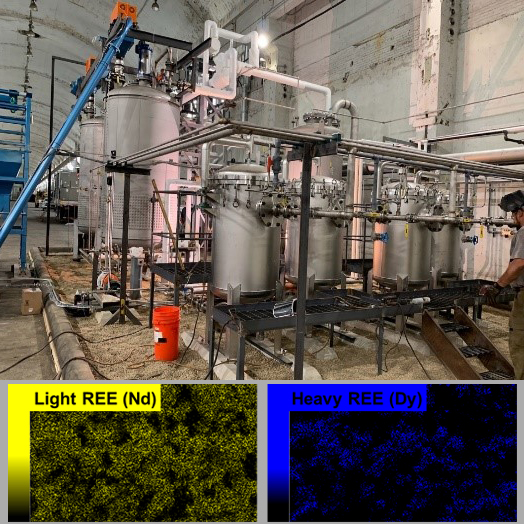
Top: REE Pilot Plant. Bottom: SEM-EDX images of REE materials produced using the PSI process.
Sorbent Production
Metal-Organic Frameworks (MOFs) are advanced porous materials composed of inorganic and organic components, characterized by their exceptionally high internal surface areas. Their unique properties have driven significant interest in applications such as catalysis, gas storage, and molecular separations. PSI has engineered novel continuous flow processes to rapidly synthesize specific MOFs for these critical applications. Leveraging our integrated vertical capabilities, PSI manages the entire lifecycle—from producing the sorbent powder to shape-engineering the material into desired form factors and rigorously validating its properties in-house. This end-to-end approach accelerates the transition from synthesis to fully characterized, functional materials.
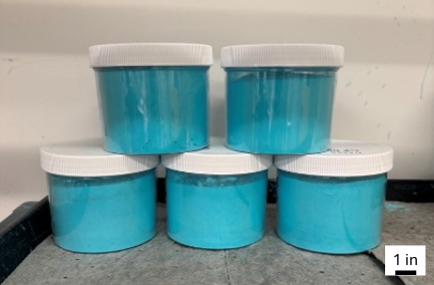
1 kg of MOF produced with PSI’s continuous reactor system.
|
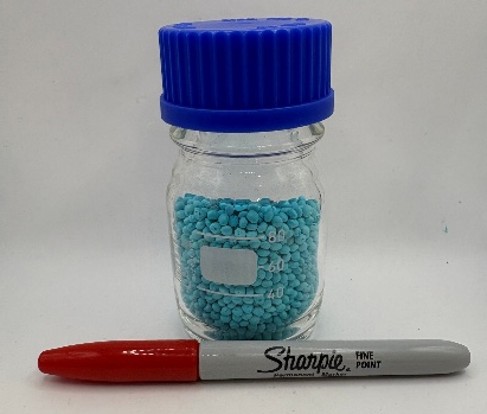
Image of shape engineered MOF particles for gas storage
and separations applications produced with PSI’s continuous process.
|